If you’ve spent time on Snapchat, texting apps, or social media conversations, you’ve probably come across the term iMsg and wondered what it actually means. Many people see it in messages and assume it’s a new slang expression, while others think it has something to do with Snapchat features.
The confusion is understandable because online communication moves quickly, and abbreviations often take on different meanings depending on the platform and context.
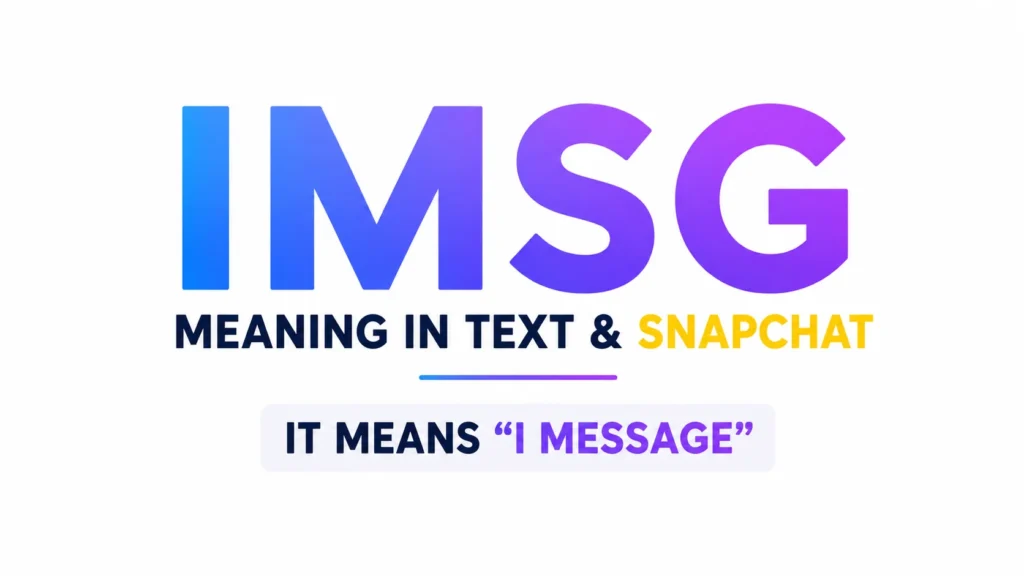
In most cases, iMsg is short for iMessage, Apple’s messaging service available on iPhones, iPads, and other Apple devices. When someone says “send me an iMsg” or “I got your iMsg,” they are usually referring to a message sent through Apple’s iMessage system rather than a standard SMS text.
Understanding this term helps avoid misunderstandings, especially when chatting with friends who switch between Snapchat, Instagram, WhatsApp, and traditional texting apps.
iMsg – Quick Meaning
iMsg stands for iMessage.
It is commonly used as a shortened way to refer to Apple’s messaging platform.
Quick Facts
- iMsg = iMessage
- Used mainly by Apple device users
- Refers to messages sent through Apple’s internet-based messaging service
- Common in text conversations and social media chats
- Not officially a Snapchat feature
Example Uses
“Can you send me an iMsg instead?”
“I saw your iMsg this morning.”
“My iMsg didn’t go through.”
These examples show how people casually shorten the word iMessage during conversations.
Origin & Background
The abbreviation iMsg developed naturally from Apple’s iMessage service.
Apple introduced iMessage in 2011 as an alternative to traditional SMS messaging. The service allowed users to send texts, photos, videos, voice notes, and other content using an internet connection.
As mobile communication became faster, users began shortening frequently used words. Just as “message” became “msg,” iMessage eventually became “iMsg” in casual conversations.
Social media platforms contributed to the popularity of the abbreviation. Users discussing messaging preferences on Snapchat, Instagram, TikTok, and X often preferred shorter terms that could be typed quickly.
The abbreviation never became an official Apple term. Instead, it grew through everyday online communication.
Today, many younger users recognize iMsg immediately, while others may need additional context when encountering it for the first time.
Real-Life Conversations
WhatsApp Conversation
Andrew:
Why didn’t you reply yesterday?
David:
I thought I did.
Andrew:
I only got your WhatsApp message.
David:
Oh, I sent the details through iMsg.
Andrew:
That explains it. I wasn’t checking my iPhone.
Instagram DM
Sophia:
Can you send me the address?
Emma:
Sure.
Sophia:
Instagram keeps hiding our messages.
Emma:
I’ll send it through iMsg instead.
Sophia:
Perfect. Thanks.
TikTok Comments
Liam:
How did you two become friends?
Noah:
We met online years ago.
Liam:
Still talking?
Noah:
Every day. Mostly through iMsg now.
Text Message
Jessica:
Did you get the photos?
Michael:
Not yet.
Jessica:
I sent them by iMsg earlier.
Michael:
Found them. My notifications were off.
Emotional & Psychological Meaning
On the surface, iMsg appears to be nothing more than a technical abbreviation.
Its deeper meaning often relates to connection, convenience, and familiarity.
When someone asks another person to use iMsg, they may prefer faster communication, better media sharing, or a platform they check more frequently.
Many friendships and relationships develop communication habits around specific apps. The choice of platform can become part of a person’s routine.
I remember a friend who always preferred iMessage over social media chats. Whenever something important came up, she would say, “Send me an iMsg.” For her, that platform felt more personal and reliable than public-facing social networks.
Small communication preferences like these reveal how digital tools shape modern relationships.
Usage in Different Contexts
Social Media
People frequently mention iMsg while discussing where conversations should continue.
Someone might say:
“DM me first, then send the details through iMsg.”
Friends and Relationships
Among friends, the term is used casually.
It often signals a preference for direct and private communication.
Work and Professional Settings
Professional environments usually favor the full term “iMessage.”
Using iMsg may appear too informal in formal business communication.
Casual vs Serious Tone
Casual conversations commonly use abbreviations.
Serious discussions, official messages, and workplace communication often benefit from clearer wording.
When NOT to Use It
Although iMsg is widely understood by many people, there are situations where it may create confusion.
Formal Communication
Professional emails and business documents should generally use “iMessage” rather than iMsg.
Mixed Technology Groups
Not everyone uses Apple devices.
Some recipients may not immediately understand the abbreviation.
International Audiences
Certain regions rely heavily on WhatsApp or other messaging platforms.
The term may be less familiar there.
Technical Discussions
When explaining messaging services, using the complete name often improves clarity.
Common Misunderstandings
Several misconceptions surround the term.
It Is Not a Snapchat Feature
Many users discover the term while using Snapchat and assume it belongs to Snapchat.
Actually, it refers to Apple’s messaging platform.
It Is Not a Separate App
iMsg is simply shorthand for iMessage.
There is no separate application called iMsg.
It Is Not Internet Slang for an Emotion
Unlike abbreviations such as LOL or BRB, iMsg does not express a feeling or reaction.
It Does Not Replace SMS
People sometimes use iMsg and text message interchangeably, though they technically function differently.
Comparison Table
| Term | Meaning | Relationship to iMsg |
|---|---|---|
| iMsg | iMessage | Main term |
| iMessage | Apple’s messaging service | Full version |
| SMS | Standard text message | Alternative |
| MMS | Multimedia message | Related messaging format |
| DM | Direct message | Different platform |
| PM | Private message | Similar communication style |
| Chat | General conversation | Broader term |
| Electronic mail | More formal option |
Key Insight
The biggest source of confusion comes from platform overlap. People often move between Snapchat, Instagram, WhatsApp, and texting apps throughout the day. As a result, abbreviations like iMsg become shortcuts for identifying where a conversation is taking place.
Variations / Types
1. iMsg
Short form of iMessage.
2. iMessage
The complete platform name.
3. Msg
General abbreviation for message.
4. Blue Message
Refers to Apple’s iMessage bubbles.
5. Group iMsg
An iMessage sent within a group chat.
6. Personal iMsg
A direct one-to-one iMessage.
7. Media iMsg
An iMessage containing photos or videos.
8. Voice iMsg
An audio message sent through iMessage.
9. Quick iMsg
A short and immediate response.
10. Follow-Up iMsg
A message sent after an earlier conversation.
How to Respond When Someone Uses It
Casual Replies
- “Sure, send me an iMsg.”
- “I just checked my iMessages.”
- “I’ll message you there.”
Funny Replies
- “My iMsg inbox is working overtime.”
- “The iMsg delivery team finally arrived.”
- “I’ll respond before my phone starts judging me.”
Mature Replies
- “I received your iMsg and will reply shortly.”
- “Thank you for sending the information.”
- “I appreciate the update.”
Respectful Replies
- “Got it. I’ll check my messages.”
- “Thank you for letting me know.”
- “I received everything successfully.”
Regional & Cultural Usage
Western Culture
The abbreviation is commonly recognized among Apple users.
Many people still prefer saying iMessage in full.
Asian Culture
Usage varies by country because messaging habits differ significantly.
Apps such as WhatsApp, LINE, and other platforms may dominate communication.
Middle Eastern Culture
People often switch between messaging apps depending on personal preferences and social circles.
The abbreviation is generally understood among Apple users.
Global Internet Usage
Online communities frequently use shortened forms to save time and typing effort.
iMsg fits naturally into this trend.
Generational Differences
Gen Z often embraces abbreviations and platform-specific language.
Millennials tend to understand iMsg but may alternate between the abbreviation and the full term.
Is It Safe for Kids?
Yes. The term itself is safe for children because it simply refers to Apple’s messaging platform.
Parents should focus on safe messaging habits, privacy settings, and responsible online communication rather than the abbreviation itself.
FAQs
What does iMsg mean in texting?
iMsg usually means iMessage, Apple’s internet-based messaging service.
Does iMsg mean something different on Snapchat?
No. It generally still refers to iMessage, even when mentioned on Snapchat.
Is iMsg an official Apple abbreviation?
No. It is an informal shorthand created by users.
Can Android users send iMsg?
Traditional iMessage functionality is designed for Apple devices.
Why do people say iMsg instead of iMessage?
The shorter version is quicker to type during casual conversations.
Is iMsg slang?
Not exactly. It is more of a communication abbreviation than internet slang.
Does iMsg mean direct message?
No. Direct message is usually shortened to DM, not iMsg.
Conclusion
Understanding what iMsg means in text and Snapchat conversations can remove a lot of unnecessary confusion. In most situations, the abbreviation simply refers to Apple’s iMessage service.
The term became popular because people naturally shorten commonly used words when chatting online. While it often appears in Snapchat messages, Instagram DMs, and text conversations, its meaning remains largely the same.
Once you know that iMsg is simply a quick way of saying iMessage, you’ll recognize it instantly and use it confidently whenever it appears in digital conversations.