If you’ve spent time texting, scrolling through social media, or chatting with friends online, you’ve probably seen the abbreviation WYA pop up in messages. It appears in casual conversations every day, yet many people still wonder exactly what it means and when they should use it.
The confusion usually comes from the fact that internet slang changes quickly. A simple three-letter abbreviation can carry different tones depending on who sends it and why.
Understanding WYA helps you communicate more naturally in modern digital conversations. Whether you’re texting friends, replying to someone you’re interested in, or trying to keep up with online slang, knowing how this expression works can prevent misunderstandings and make conversations flow more smoothly.
WYA – Quick Meaning
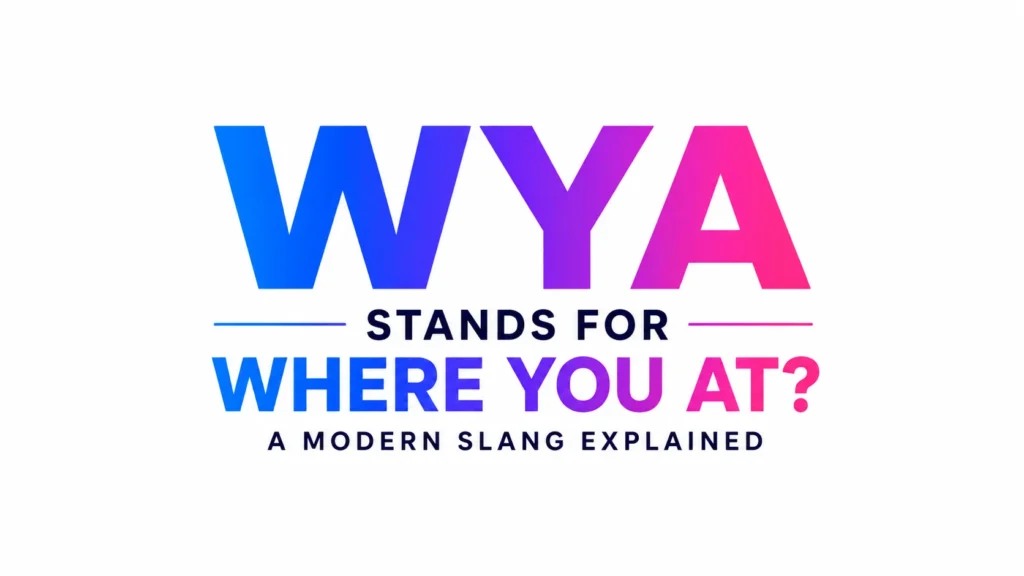
WYA stands for “Where You At?”
It is an informal way of asking someone where they are or what they are currently doing.
Quick Definition
- Means: “Where are you?”
- Used mainly in text messages and social media chats
- Casual and conversational
- Often used among friends, family members, or romantic interests
Examples
“WYA? We’re waiting for you.”
“Hey, WYA right now?”
“WYA tonight? Everyone is meeting up.”
The phrase is usually friendly and direct. The tone depends on the relationship between the people involved.
Origin & Background
WYA developed from spoken conversational English, particularly the phrase “Where you at?” which has been common in everyday speech for decades.
As texting became more popular during the late 1990s and early 2000s, people started shortening phrases to save time and characters. Just as “BRB” became “Be Right Back” and “LOL” became “Laugh Out Loud,” “Where You At?” naturally evolved into WYA.
Social media accelerated its popularity. Platforms like Instagram, Snapchat, TikTok, and WhatsApp encouraged shorter messages and quick interactions.
The abbreviation became especially common among younger users who preferred fast, efficient communication. Over time, WYA moved beyond simply asking for a location. In many conversations, it can also imply:
- What are you doing?
- Are you available?
- Why haven’t you responded?
- Do you want to hang out?
That flexibility explains why WYA remains widely used today.
Real-Life Conversations
WhatsApp Conversation
Andrew:
WYA? The movie starts in 15 minutes.
David:
Almost there. Traffic is moving slowly.
Andrew:
Good. We already got your ticket.
Instagram DM
Sophia:
WYA these days? Haven’t seen you online much.
Emma:
Been busy with work lately.
Sophia:
Makes sense. Hope everything’s going well.
TikTok Comments
Liam:
WYA when this song drops at midnight?
Jake:
Right here refreshing the page every minute.
Liam:
Same. Can’t wait.
Text Message
Andrew:
WYA?
David:
At home. Why?
Andrew:
We’re grabbing dinner. Want to come?
David:
Sure, give me 20 minutes.
Emotional & Psychological Meaning
On the surface, WYA is simply a question about location.
Underneath that simple wording, it often expresses a desire for connection.
People frequently use WYA because they want someone’s attention, presence, or company. The phrase can communicate curiosity, concern, excitement, or even mild frustration.
For example, imagine a close friend who usually replies quickly. Hours pass without a response. Instead of sending a long message, you might simply text:
“WYA?”
The question is really saying:
“I noticed you’re missing from the conversation.”
Modern communication values speed and convenience. WYA reflects that trend while still carrying emotional meaning.
Usage in Different Contexts
Social Media
WYA appears regularly in:
- Instagram DMs
- Snapchat chats
- TikTok comments
- Facebook Messenger
- X posts and replies
Users often employ it to start conversations quickly.
Friends and Relationships
Among friends, WYA is commonly used to coordinate plans.
In romantic situations, it can signal interest or affection.
A late-night “WYA?” may carry a very different tone than an afternoon message about meeting for lunch.
Work and Professional Settings
WYA is generally not appropriate in professional communication.
Instead, use phrases such as:
- “Where are you currently located?”
- “Are you available?”
- “Can you provide an update?”
Professional environments usually require clearer and more formal wording.
Casual vs Serious Tone
Casual:
“WYA? Come join us.”
Serious:
“WYA? Everyone is worried about you.”
Context changes how the message feels.
When NOT to Use It
Although WYA is common, there are situations where it may not be the best choice.
Formal Business Communication
Avoid using slang in professional emails or official messages.
Sensitive Situations
If someone is dealing with a personal challenge, a more thoughtful message may be better.
With People Unfamiliar With Slang
Not everyone understands internet abbreviations.
Important Discussions
Clear communication is often better than shorthand when details matter.
Common Misunderstandings
Several misconceptions surround WYA.
Assuming It Only Means Location
Many people think it only asks where someone physically is.
In reality, it can also mean:
- What are you doing?
- Are you available?
- Why haven’t you replied?
Reading Too Much Into It
A simple WYA does not automatically indicate romantic interest.
Sometimes people genuinely want to know your location.
Tone Confusion
Text lacks facial expressions and voice cues.
A friendly WYA can sometimes appear demanding if the relationship is unclear.
Comparison Table
| Expression | Meaning | Tone |
|---|---|---|
| WYA | Where are you? | Casual |
| WYD | What are you doing? | Casual |
| HBU | How about you? | Friendly |
| BRB | Be right back | Informal |
| GTG | Got to go | Casual |
| IMO | In my opinion | Conversational |
| Missing you | Expressing absence | Emotional |
| Leave me alone | Opposite sentiment | Distant |
Key Insight
WYA stands out because it combines practicality and social connection. It asks for information while often signaling a desire to interact.
Variations and Types
1. WYA RN
Where are you right now?
2. WYA Tonight
Asking about evening plans.
3. WYA Bro
Friendly version used among close friends.
4. WYA Fam
Directed toward family members or close circles.
5. WYA At
An extended version of the same question.
6. WYA Though
Often used when someone seems absent.
7. WYA Been
Asking where someone has been recently.
8. WYA Lately
Checking in after a long absence.
9. WYA ASAP
Requesting a quick response.
10. WYA Everybody
Directed toward a group rather than an individual.
How to Respond When Someone Uses It
Casual Replies
- “At home.”
- “Just got to work.”
- “Out with friends.”
Funny Replies
- “Somewhere on planet Earth.”
- “Currently avoiding responsibilities.”
- “Hidden in plain sight.”
Mature Replies
- “I’m busy right now but I’ll call later.”
- “Running errands at the moment.”
Respectful Replies
- “Thanks for checking in. I’m doing well.”
- “I’m currently unavailable but I’ll respond soon.”
Regional & Cultural Usage
Western Culture
WYA is extremely common among teenagers and young adults. It is often used casually without much thought.
Asian Culture
Many younger internet users understand WYA through exposure to global social media. Local messaging habits may influence how frequently it appears.
Middle Eastern Culture
The abbreviation is recognized among many English-speaking users online. Direct translations are not always common in local languages.
Global Internet Usage
Social platforms have made WYA recognizable across countries. Many users understand it even when English is not their first language.
Gen Z vs Millennials
Gen Z
- Uses WYA frequently
- Comfortable with abbreviations
- Often combines it with emojis
Millennials
- Understand it easily
- May alternate between shorthand and full sentences
Both generations recognize the expression, though younger users tend to rely on it more often.
Is It Safe for Kids?
Yes, WYA is generally safe for kids because it simply means “Where You At?” or “Where are you?”
Parents should still encourage children to be cautious when sharing their location online. The phrase itself is harmless, but location information should always be shared responsibly.
FAQs
What does WYA stand for in texting?
WYA stands for “Where You At?” and is used to ask someone’s location or availability.
Is WYA rude?
No. It is usually friendly and casual, though tone depends on context.
Can WYA be flirtatious?
Yes. Some people use it to start conversations with someone they like.
Is WYA used on Snapchat?
Absolutely. It is commonly used on Snapchat, Instagram, TikTok, and text messages.
What is the difference between WYA and WYD?
WYA asks where someone is, while WYD asks what someone is doing.
Do adults use WYA?
Yes. Many adults use it in casual conversations, especially online.
Is WYA professional?
Generally no. Formal communication usually requires complete sentences.
Conclusion
WYA is one of the most common abbreviations in modern digital communication. While it literally means “Where You At?”, its purpose often goes beyond asking for a location.
The phrase can express curiosity, friendship, concern, interest, or a desire to reconnect. Its popularity comes from being short, simple, and adaptable across many types of conversations.
Once you understand the tone and context behind WYA, you’ll recognize it instantly and feel more confident using it in messages, social media chats, and everyday online interactions.