If you’ve received a message that simply says “WYA?” you’re not alone. This short abbreviation appears everywhere, from text messages and group chats to social media platforms and online communities.
Many people search for the meaning of WYA because the phrase is brief, informal, and highly dependent on context. Someone unfamiliar with modern texting culture may wonder whether it’s a greeting, a question, or something more personal.
The good news is that the meaning is usually straightforward. Once you understand how people use it, you’ll notice it appearing in everyday conversations across different platforms and age groups.
This guide explains what WYA stands for, where it came from, how it is used, and what it can reveal about modern communication habits.
WYA Stands For – Quick Meaning
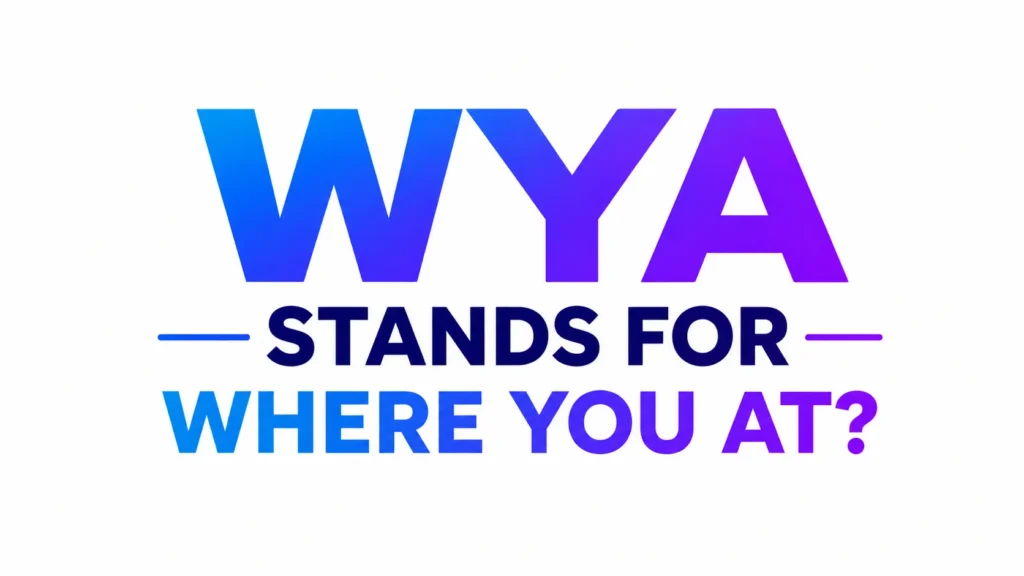
WYA stands for “Where You At?”
It is an informal way of asking someone where they are currently located or what they are doing.
People use it to:
- Ask for someone’s location
- Check whether someone is available
- Start a conversation
- Coordinate plans
- Reconnect with friends
Examples:
“WYA? Everyone is already here.”
“WYA tonight?”
“Hey, WYA? Haven’t heard from you.”
Although it literally asks about location, the phrase often carries a broader social meaning.
Origin & Background
WYA originated from spoken informal English, particularly in urban and youth culture where “Where you at?” became a common conversational phrase.
As texting grew in popularity during the late 1990s and early 2000s, people began shortening frequently used expressions. WYA emerged alongside abbreviations such as LOL, BRB, IMO, and IDK.
The rise of smartphones accelerated its popularity. Messaging apps encouraged quick communication, making short forms more practical than complete sentences.
Social media also played an important role. Platforms such as Instagram, Snapchat, TikTok, and X helped spread internet slang across countries and cultures.
Over time, WYA evolved beyond asking for a physical location. In many conversations, it became a way to ask:
- What are you doing?
- Are you available?
- Why haven’t you replied?
- Do you want to hang out?
That flexibility explains why the abbreviation remains popular today.
Real-Life Conversations
WhatsApp Conversation
Andrew:
WYA?
David:
Just left work.
Andrew:
A few of us are grabbing dinner.
David:
Give me twenty minutes and I’ll join.
Instagram DM
Sophia:
WYA? I haven’t seen you post anything today.
Emma:
Been studying all afternoon.
Sophia:
That explains the silence.
Emma:
I needed a break from social media.
TikTok Comments
Ryan:
WYA when this song drops live?
Mason:
Front row if I can get tickets.
Ryan:
Same here.
Mason:
It’s going to be unforgettable.
Text Message
Olivia:
WYA?
James:
At the airport.
Olivia:
Already?
James:
My flight got moved earlier.
Emotional & Psychological Meaning
WYA may appear simple, yet it often carries emotional undertones.
Sometimes it reflects excitement. A friend wants to see you and is checking your availability.
In other situations, it can signal concern. Someone who has not heard from you may use WYA to make sure everything is okay.
The phrase can also express anticipation. When plans are approaching, people naturally want updates about where everyone is.
Modern communication values instant connection. WYA fits perfectly into that environment because it quickly opens a conversation without requiring a long message.
I have often seen friends send WYA after a period of silence. The message wasn’t really about location. It was a gentle way of saying, “I’m thinking about you and want to reconnect.”
That emotional layer explains why the phrase feels more personal than many other abbreviations.
Usage in Different Contexts
Social Media
WYA appears frequently in comments, direct messages, stories, and group chats.
People use it to engage with friends, followers, and online communities.
Friends & Relationships
Among friends, WYA is usually casual and friendly.
In romantic relationships, it can show interest, curiosity, or a desire to spend time together.
Work and Professional Settings
WYA is generally too informal for most professional communication.
Instead, people often use:
- Where are you currently?
- Are you available?
- Have you arrived yet?
These alternatives sound more polished and appropriate.
Casual vs Serious Tone
In casual settings, WYA feels natural and conversational.
During serious discussions, the abbreviation may seem overly informal or vague.
Context shapes how it is received.
When NOT to Use It
Avoid using WYA in the following situations:
- Formal business emails
- Academic communication
- Professional reports
- Customer support interactions
- Legal discussions
- Sensitive personal conversations
Some people may interpret repeated WYA messages as pressure or impatience.
Respecting boundaries and timing is important.
Cultural expectations can also influence how the phrase is perceived.
Common Misunderstandings
It Always Means Location
Not necessarily.
Many people use WYA to ask about someone’s availability or activity rather than their physical location.
It Is Always Romantic
The phrase is commonly used among friends, family members, classmates, and coworkers.
Romantic intent depends on context.
It Sounds Demanding
Some recipients interpret WYA as demanding.
Others view it as a friendly conversation starter.
Tone, relationship, and timing all matter.
Literal vs Figurative Meaning
Literally, WYA asks where someone is.
Figuratively, it may mean:
- What’s going on?
- Are you around?
- Are you free?
- Why have you disappeared?
Comparison Table
| Expression | Meaning | Typical Tone |
|---|---|---|
| WYA | Where you at? | Casual |
| WYD | What are you doing? | Friendly |
| HMU | Hit me up | Open invitation |
| BRB | Be right back | Temporary absence |
| IDK | I don’t know | Neutral |
| ETA? | Expected arrival time? | Planning-focused |
| See you later | Future meeting | Positive |
| Gone for now | Not available | Opposite idea |
Key Insight
WYA is unique because it often combines location, availability, and social interest into a single question. Few abbreviations accomplish all three at once.
Variations / Types
1. WYA
Standard version meaning “Where you at?”
2. WYA rn
Asks where someone is right now.
3. WYA tho
Adds curiosity or emphasis.
4. WYA lol
Creates a playful tone.
5. WYA tonight
Focuses on evening plans.
6. WYA at
An extended version still common in texting.
7. WYA bro
Friendly version used among close friends.
8. WYA fam
Group-oriented variation.
9. WYA ASAP
Requests a quick response.
10. WYA these days
Used when reconnecting after a long time.
How to Respond When Someone Uses It
Casual Replies
- At home.
- Just got to work.
- Out with friends.
- Heading downtown.
Funny Replies
- Hidden from responsibilities.
- Somewhere with snacks.
- Surviving the day.
- On a mission for coffee.
Mature Replies
- I’m at the office right now.
- Currently busy but free later.
- Traveling today. I’ll reply when available.
Respectful Replies
- Thanks for checking in.
- I’m doing well and currently at home.
- I appreciate you reaching out.
Regional & Cultural Usage
Western Culture
WYA is extremely common among younger users and frequent texters.
The abbreviation is often used without additional explanation.
Asian Culture
Many English-speaking internet users understand WYA, especially those active on social media and international platforms.
Local language preferences may still dominate daily communication.
Middle Eastern Culture
WYA is familiar among younger bilingual users and online communities.
Usage tends to increase in digital spaces influenced by global internet culture.
Global Internet Usage
The abbreviation has become part of a shared online vocabulary used across many countries.
Its popularity continues because it is quick, practical, and easy to understand.
Generational Differences
Gen Z
Uses WYA frequently in chats, group conversations, and social media interactions.
Millennials
Generally understand the phrase and use it comfortably, though many alternate between abbreviations and full sentences.
Older generations may recognize the meaning but often prefer complete wording.
Is It Safe for Kids?
Yes, WYA is generally safe for kids.
The phrase itself is harmless and simply asks about someone’s location or availability. Parents should still teach children to be cautious when sharing personal location details online, especially with people they do not know well.
Context and online safety remain important.
FAQs
What does WYA stand for in texting?
WYA stands for “Where You At?” It is a casual way of asking where someone is or what they are doing.
Is WYA rude?
No. Most people use it casually and without negative intent.
What should I reply to WYA?
You can share your location, activity, or availability depending on the situation.
Is WYA used on Snapchat?
Yes. It is commonly used on Snapchat, Instagram, TikTok, WhatsApp, and text messages.
Does WYA mean someone likes you?
Not necessarily. Friends, relatives, and coworkers also use it regularly.
Is WYA professional?
The abbreviation is generally considered too informal for professional communication.
Why do people say WYA instead of writing the full phrase?
It saves time and matches the fast pace of modern digital conversations.
Conclusion
WYA stands for “Where You At?” and remains one of the most widely used texting abbreviations in modern communication. While the phrase often asks about someone’s location, it frequently carries a deeper social purpose.
A simple WYA can signal curiosity, friendship, concern, excitement, or a desire to reconnect. Its popularity comes from its ability to communicate several ideas with only three letters.
Understanding the context behind the phrase helps you interpret it correctly and respond naturally. Whether it appears in a text message, a social media comment, or a direct message, you’ll know exactly what it means and how to use it with confidence.